Bookpleasures.com is excited to welcome our guest, Larry Lenchtner, a practicing psychologist who brings a wealth of clinical insight and deep personal familiarity to the study of obsessional traits and human behavior.
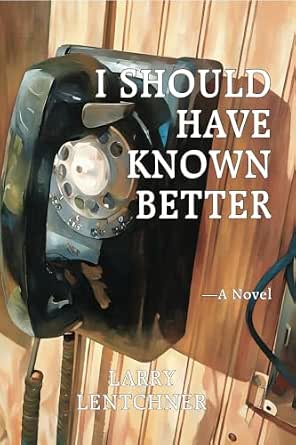
Larry is the author of three published novels, Wonderland, Sexual Survivors, The Reluctant Guru of Alphabet City, and his latest novel, I Should Have Known Better.
Larry’s professional life includes his beginnings in the New York therapeutic community movement of the late ’60s and ’70s, which was dedicated to the rehabilitation of addiction and chronic criminalism.
He later moved to New Jersey where he began a private psychotherapy practice which he still maintains.
Larry divides his time between Florida and New Jersey.
Today, we will explore how his latest novel, I Should Have Known Better, delves into obsession, relationships, and memory, aiming to resonate deeply with readers’ own experiences.
Good day, Larry, and thanks for taking part in our interview.
Norm: Larry, the title I Should Have Known Better captures a universal feeling we’ve all muttered at two in the morning; was there a specific moment in your own life where you thought it and realized it was a book, and do you think Phil ever actually learns, or is the point that most of us don’t?

Larry: Phil is blessed/cursed with being both neurotic and self aware. He consistently learns, yet is driven back to the non-stop questioning. Only when he eventually is forced to surrender does he fully learn. Like most of us.
Norm: Why did you choose an episodic, memoir-style journal-entry structure that makes it feel like we’re reading someone’s private files instead of traditional chapters, and did writing in short bursts change how the story came out?
Larry: I chose a journal structure because it allows the tortured internal mechanisms of mind to voice themselves. Also to allow the flow of Phils life to emerge organically.
Norm: Phil’s “inquisitor”—that brutal inner critic narrating his every mistake—is both hilarious and painful; where did that voice come from, and do you hear your own inquisitor while you’re writing, and what does it say?
Larry: Of course I have an active and pain in the ass Inquisitor. It drives me whether I am being a psychotherapist or writing or just trying to hand a new painting in the right spot at the right angle. Again, a curse and a blessing.
Norm: Let’s talk about Sheila Allenberg, who is magnetic, maddening, and unforgettable; is she based on one person, a composite, or the kind of person every young man in 1960s New York seemed to meet, and since you call her Phil’s “poison type,” do you think most people have one?
Larry: I believe all of us have a “poison type” who fits all of our neurotic needs and wants, not the person who fulfills the needs and wants of our true self. Note that Sheila’s transformation as well as Phil’s allows this typology.
Norm: The pancake party meet-cute is an all-timer, so did that scene come to you first, or did the characters come first? Also, since Phil judges people by their bookcases like Hemingway, Kerouac, and Miller, what would your own bookcase say about you?
Larry: My bookcase suggests my eclectic disposition, with Dylan Thomas and Carl Jung and Robert Heinlein leading the pack.
Norm: Where on earth did you come up with Polyphemus, the one-eyed dragon who shoots flaming matza balls for Mythological Toys, and did you ever secretly wish the toy business had actually worked?
Larry: Polyphemus is an autobiographical vestige of my father entertaining my sister and myself while driving long journey’s in the car.
Norm: Phil’s vow to “do it right” with no sex until there’s real intimacy spectacularly backfires; were you rooting for him to pull it off, or did you know it was doomed, and what do you want younger readers to take from that particular romantic disaster?
Larry: Of course it was doomed. But I wish that young readers would learn that physical intimacy is always stronger and more profound if emotional intimacy precedes it.
Norm: The 1960s Alphabet City scenes feel so lived-in with the walk-ups, the weed smoke, and the JFK debates; how much is memory and how much is research, and what’s one detail from that era you loved including that younger readers might not believe was real?
Larry: The East Village and Alphabet City has a vibrancy that reflected the best of an emerging vision that was flowing directly our of defunct immigrant housing. It said something about social dialectics.
Norm: Phil’s pivot to the Bowery Project is the emotional heart of the book, where you write about ladling soup with real reverence; why was that work so important to show, and how did you go about creating George Bloomstein, who steals every scene he’s in?
Larry: My lifetime’s work as a psychologist working with addiction seems to infiltrate most every aspect of my life. I hope that George incorporates the sense of purpose and meaning that is present in all the folks who dedicate themselves to the healing of addicted souls.
Norm: You’re very frank about sex—the good, the awkward, the transcendent, and the disappointing; was that a deliberate choice to be honest rather than titillating, and was there a scene you hesitated to include?
Larry: try to be as straight-forward descriptive as possible when writing about sex, without being clinical. Sex drives us. It can’t be over or under looked.
Norm: One of the most cutting ideas in the book is that it’s not the breakup that ruins Phil, but the story he tells about it afterwards by turning Sheila into “the perfect one who got away”; what advice would you give readers who are currently mythologizing their own Sheila or Phil?
Larry: Our personal mythology can’t be avoided. My advice would be for all of us to know that we are creating our movie, and do our best to adequately play out our roles as writer, director and producer of the story, while also being the actor.
Norm: Caroline is such a refreshing contrast to Sheila, with no games, just friendship, Giants football, and honesty; was she a relief to write, and since Phil admits he never learned how to be friends with women, did writing Caroline teach you anything?
Larry: Hopefully, Phil’s relationship with Caroline allows us to appreciate the depth of friendship with our opposite gender and the difficulty of balancing our needs and drives included in these relationships. Ah, limits and boundaries, how complex these can be.
Norm: As we conclude our conversation today, where can our readers go to discover more about your background and your latest novel, I Should Have Known Better, and what enduring message do you ultimately hope they will carry away from the book?
Larry: I Should Have Known Better is the first novel I have written in which I tamed my more messianic tendencies. I hope that readers will turn to Onederland and The Reluctant Guru Of Alphabet City if they wish to step into the more directly spiritual component of my thinking.


